COMMON TIDE
T’ESSENCE MINNITEE
Common Tide
by T’Essence Minnitee
Co-Creators: T’Airrashay Minnitee & Karren McKnight
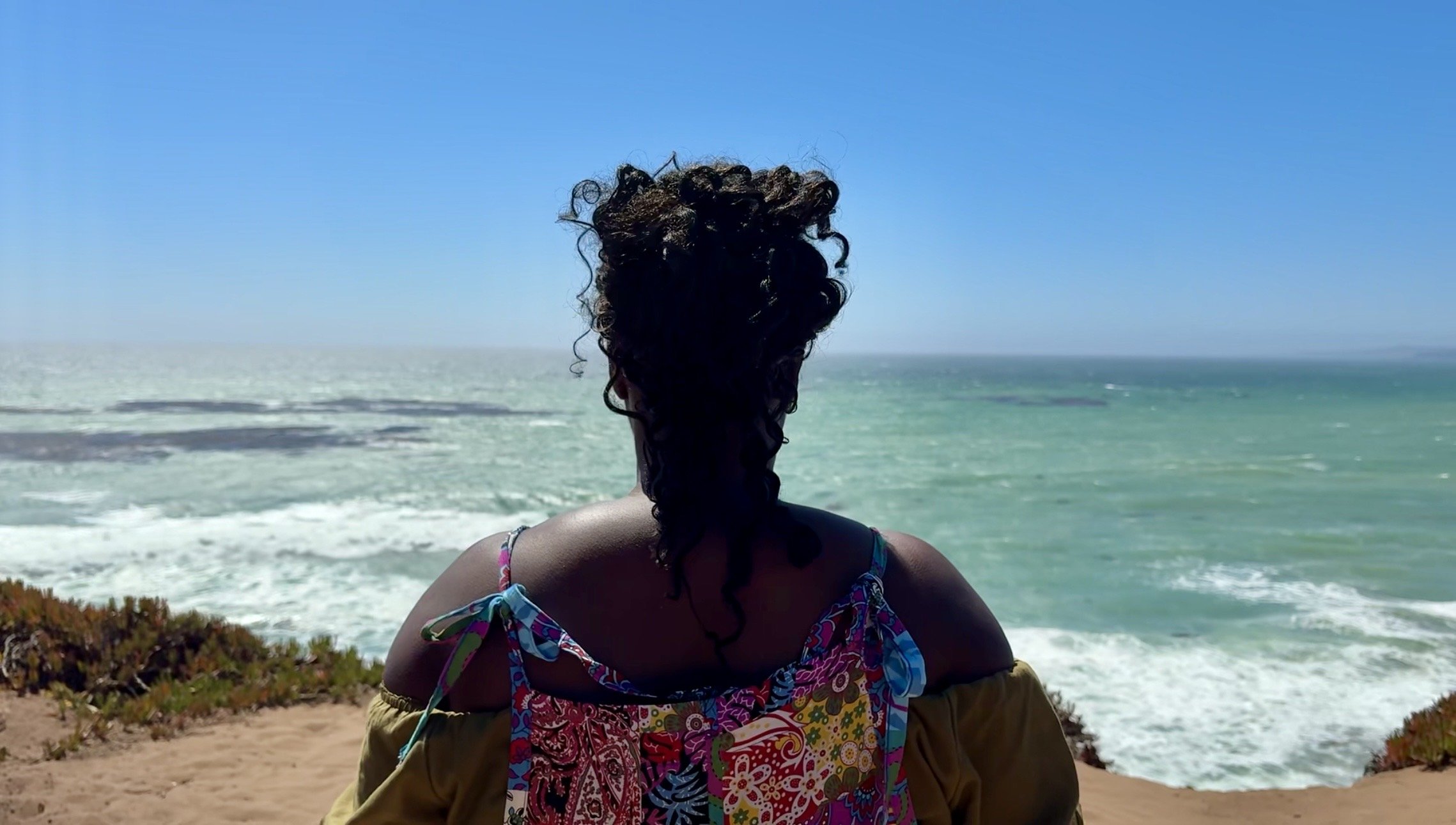
Common Tide is a speculative visual essay set in Cambria, California, in 2075. Narrated by Aisha, the film follows a future shaped not by a single technological breakthrough, but by generations of people learning how to listen to the ocean and to one another. Through memories of her grandmother and mother, Aisha describes the shoreline as a source of knowledge, kelp as both a living inheritance and a language, and stewardship as a responsibility shared across generations.
In this future, the Commons is a community system for distributing kelp, supplies, knowledge, and care. Technology supports that system by helping people recognize changes in the water, but it does not replace human judgment or ancestral understanding. The film imagines Black communities not as victims on the margins of the climate crisis, but as ocean stewards, conservation leaders, and designers of regenerative futures.
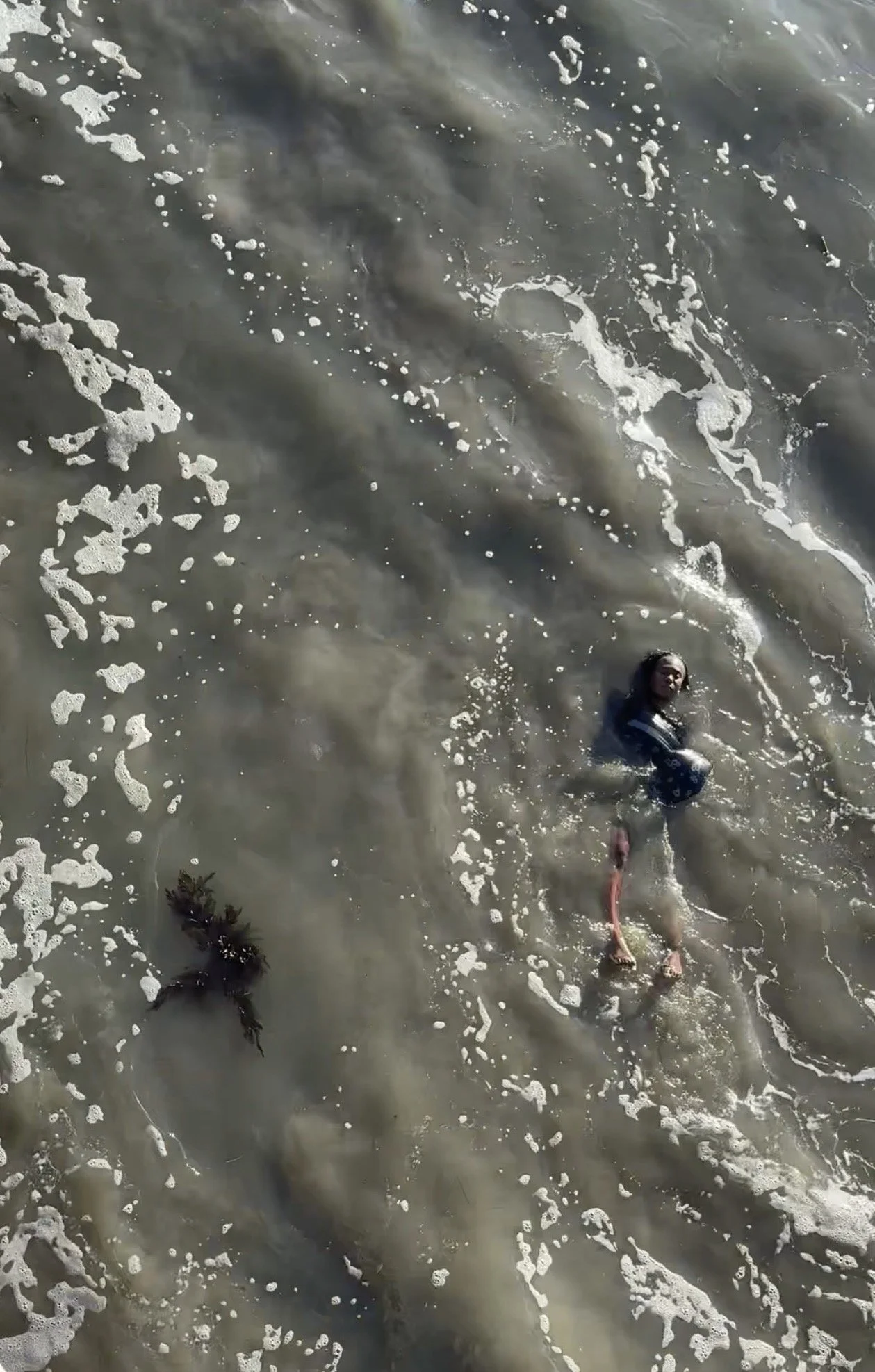
Visually, Common Tide combines natural light, tactile coastal imagery, and grounded Afrofuturist details. Aisha floating in the Pacific, harvesting kelp, watching seabirds, and preparing a storm reserve reveals a future that feels lived-in rather than distant. Its quietness is intentional: the work resists the idea that climate futures must be defined only by catastrophe or spectacle.
I want viewers to leave with a broader understanding of what climate infrastructure can be. It can include tools and systems, but it can also include trust, memory, restraint, reciprocity, and collective care. Common Tide asks us to consider what we are passing forward, whose knowledge we choose to value, and how the future will remember us.
Today’s science, T’Essence’s climate future
The climate solution most directly connected to Common Tide is the protection, restoration, and community stewardship of kelp ecosystems. NOAA’s research on canopy-forming kelp examines how kelp forests may strengthen coastal resilience by reducing wave energy and erosion while supporting food production and coastal communities.
The Shinnecock Kelp Farmers provide an equally important community model. This intergenerational collective of Indigenous women combines traditional ecological knowledge with modern aquaculture to remove excess carbon and nitrogen from Shinnecock Bay while rebuilding ecological and economic health. Their work directly inspired Common Tide’s vision of kelp as living infrastructure, inherited knowledge, and a shared community responsibility.

T’Essence Minnitee
34, California, NY
I am a multi-hyphenate filmmaker, producer, creative developer, and community organizer whose practice sits at the intersection of narrative, climate, culture, and outdoor equity. I have never fit neatly into one box as a person, artist, or professional, and I am learning to embrace that expansiveness as part of who I am. Through SISTAHS OUTSIDE and EnvironmentallyU, I create community-centered projects where these varied interests can meet. One question guides me: Who gets to imagine the future? Growing up on California’s Central Coast, I understood the ocean as a place of safety, memory, and belonging. As a little girl, I played with seaweed and kelp that washed onto the beach without knowing that something so familiar held such potential. I did not yet recognize kelp as habitat, nourishment, protection, or a material that could support regenerative practices. Discovering its many uses reshaped how I think about environmental solutions. Sometimes what we need is already around us, but recognizing its value requires us to protect it, restore what has been damaged, and engage with living systems responsibly. I have spent much of my career on the business and development side of storytelling, evaluating material, shaping projects, and carrying early concepts toward the screen. I love examining what makes an idea emotionally resonant and culturally meaningful. My goal is to pursue projects that bring me joy while expanding our sense of what can be.
Common Tide grows from that intention. This grounded, low-tech Afrofuturist visual essay allowed me to reconnect with myself as an artist and fall back in love with the process of making. Creating it with my family has been a dream come true. They shaped how I see the world, other people, and myself, and no one believes in my potential or vision as deeply as they do. They are my why. The encouragement of the Climate Futures Studio team and my cohort gave me room to experiment, trust my instincts, and follow my curiosity. The story follows Aisha, whose understanding of the shoreline comes from her grandmother, her mother, and her community. Kelp becomes a living archive: a source of sustenance, protection, responsibility, and knowledge. Technology listens before it acts, strengthening human judgment rather than replacing it. I am drawn to possibilities where ancestral practice and scientific innovation are not opposites, care is essential infrastructure, and Black and Brown communities are not simply surviving environmental change but leading what comes next. Rather than offering a perfect utopia or a single answer to the climate crisis, Common Tide invites audiences to envision a society rooted in reciprocity, collective responsibility, and the belief that no future is held by one person alone. I am excited to deepen this exploration at Columbia Climate School, where I am pursuing an MA in Climate and Society and studying the connections among science, policy, and storytelling. To connect with me and follow these projects, find me on Instagram at @tessenceminnitee, @sistahsoutside, and @environmentallyu.