sTREEt DREAMS:
THE BIG ORCHARD
Earl Lin
How can we decarbonize cities? Can we go beyond net-zero and enable cities to be restorative to nature?
Inspired by the article “Buildings like trees, city like forest,” my vision for a positive climate future of 2075 is a future of New York City where the buildings are like trees and the city is an urban forest. Flowers bloom on leaves-covered building facades. Green roofs with solar panels generate clean energy and increase biodiversity. Buildings and infrastructure are connected through thermal energy networks that share energy like the root systems of a forest. The city is powered by clean energy and filled with trees that sequester carbon and promotes plant and animal life. Urban dwellers are reconnected with nature.
Inspired by a recent trip to visit family in Fuzhou, China, I experienced a city with tree-lined streets, plant-covered bridge columns, and platoons of electric vehicles. I was deeply moved by the ink paintings I saw in a bookstore-turned-art gallery and in the museums of SanFangQiXiang. Three types of ink art inspired me the most: calligraphy with its loose, expressive brushstrokes, shanshui (mountain water) with its how it appreciates the majesty of nature, and huanaiohua (flower-bird painting) with how it highlights the relationships between plant and animal.
This project has a version of these three types: Nas’ “Street Dreams,” reimagined and written with Xu Bing’s square word calligraphy, a pigeon admiring a building covered in leaves (huaniao), and different views of New York City skyline (shanshui). My favorite thing about growing up in Brooklyn and experiencing New York City was witnessing people from all walks of life and backgrounds coexisting. New York City is the intersection of cultures, like a chunky stew with ingredients and flavors from all over the world. In that same spirit, this project mixes the arts, combining Chinese ink painting, hip-hop, calligraphy, and pen and ink art. Through this project I hope to inspire hope for a positive climate future and to reframe New York City from the big apple, as a place to chase riches, to the big orchard, as a place to tend to and connect with nature.
sTREEt DREAMS (Calligraphy)
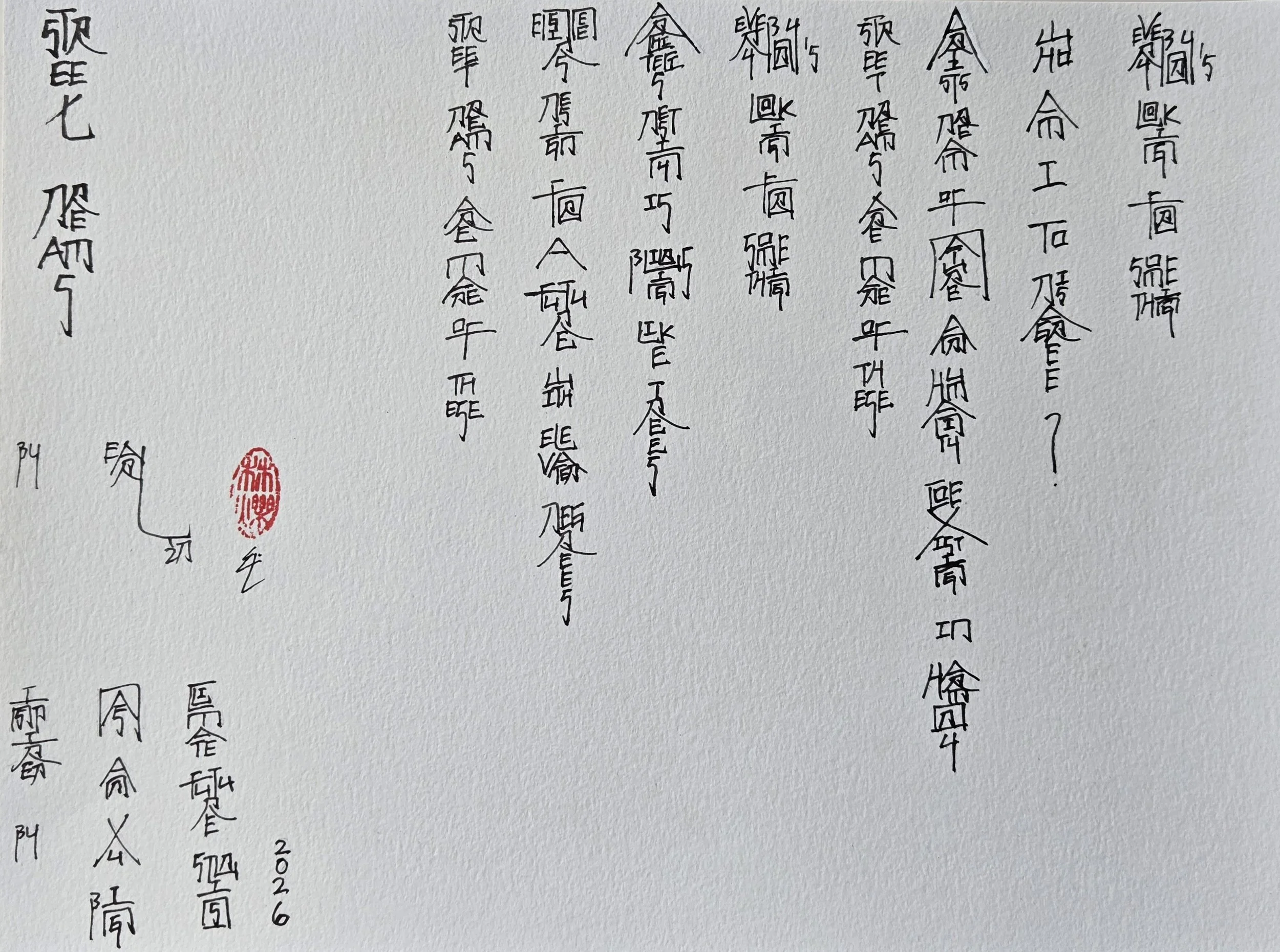
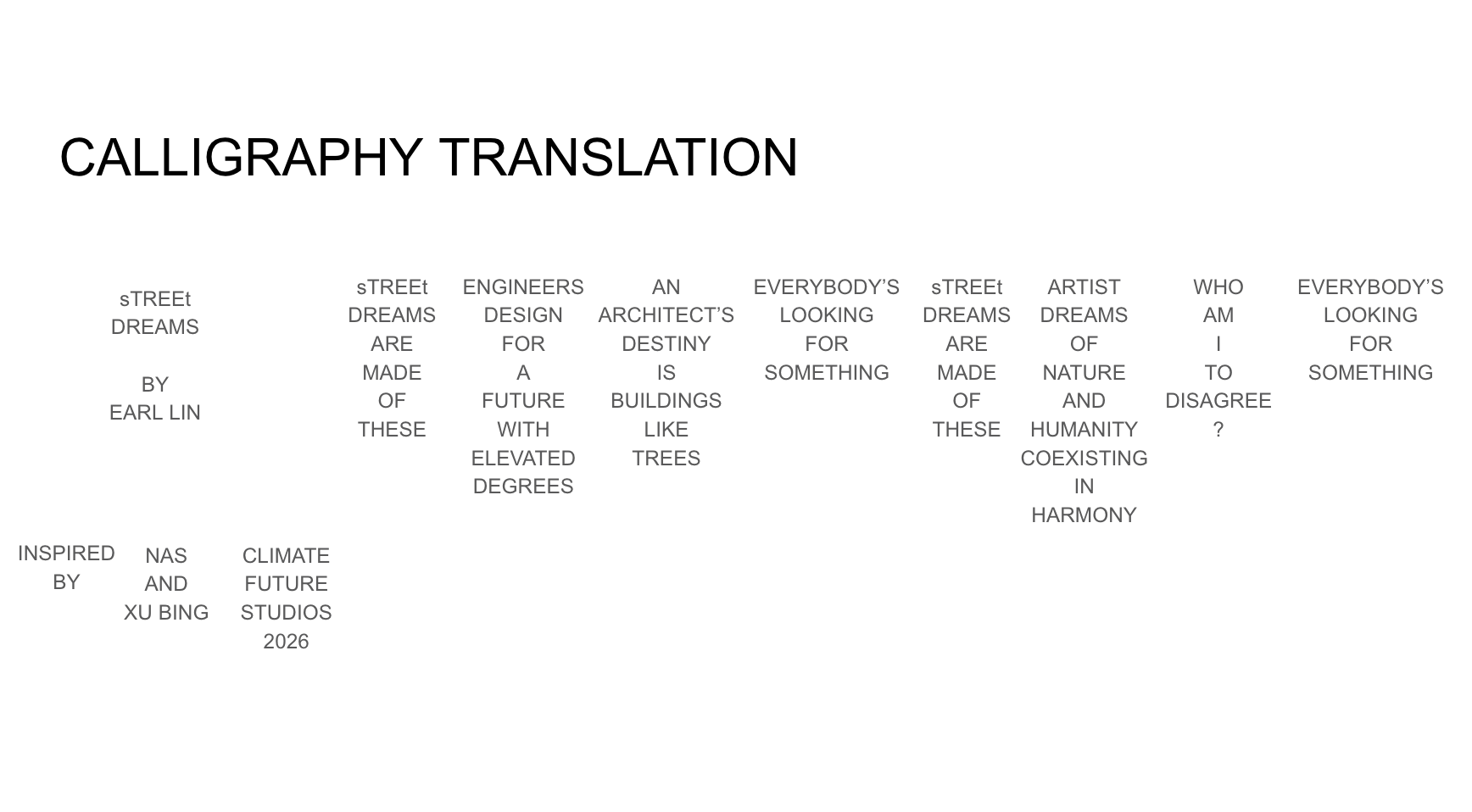
This piece reimagines the chorus of the song “Street Dreams” by Nas to reflect the themes and aspirations of this project. Growing up in New York City, I was inspired by Nas’ music and lyricism that talked about his life growing up in the Queensbridge Houses in Queens. His music made me think about how to tell my story growing up on 8th Ave in Sunset Park, Brooklyn. “Streets Dreams” is a rap song about what it was like growing up in the Queensbridge projects and how his hopes and dreams were shaped by his environment. I chose square word calligraphy to write the lyrics because it blends together English words with Chinese calligraphy and its writing system. The reconciliation of the writing systems parallels my experiences growing up Fujianese-American, trying to reconcile two cultures. This project is the realization of the “street dreams” I had when I was younger, to leave 8th ave, see the world, pursue art, and do good work for the environment.
sTREEt DREAMS
BUILDING LIKE TREE
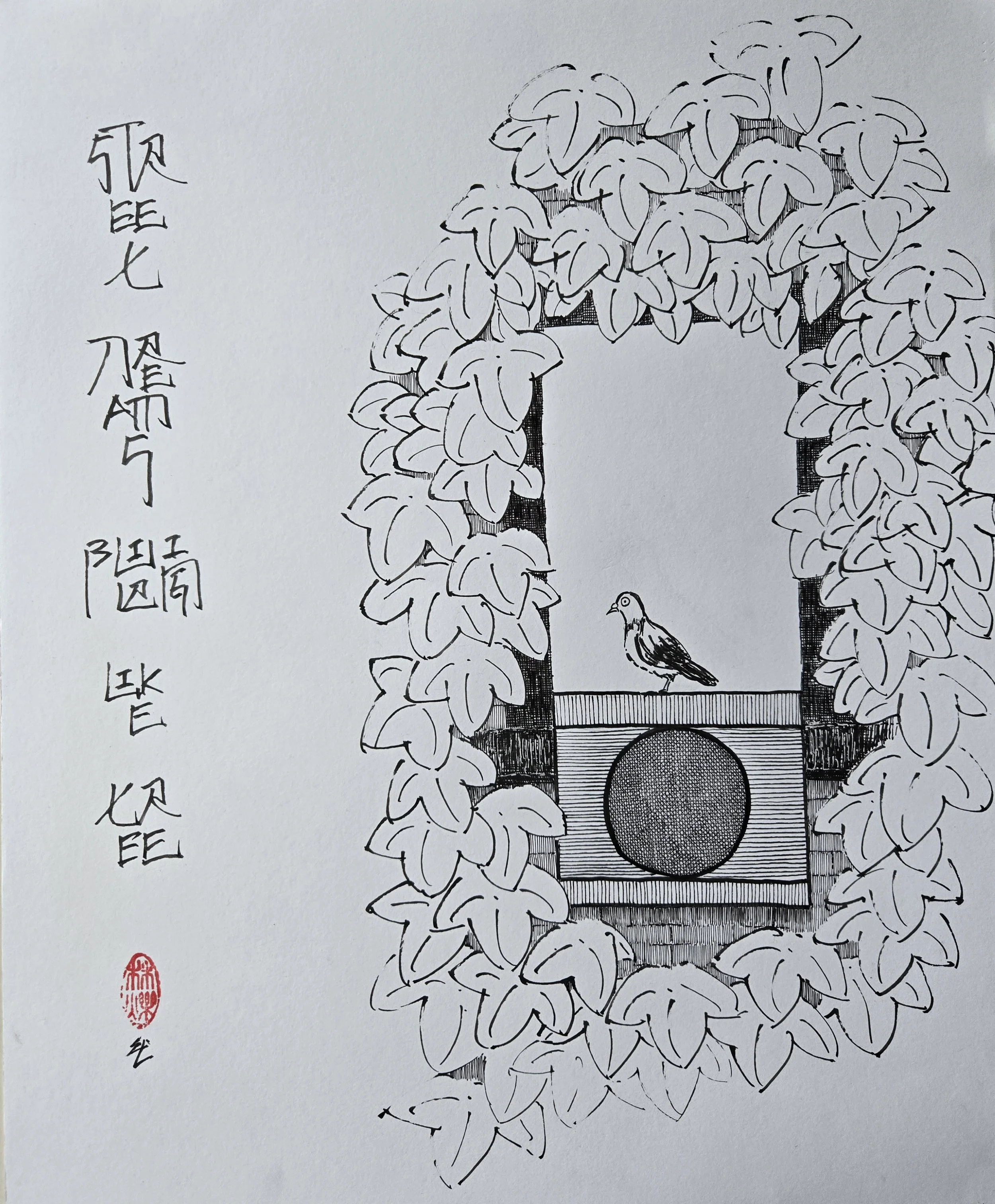
This piece reimagines a building as if it was like a tree, inspired by a form of traditional Chinese painting called huaniaohua (flower-bird-painting). The building is covered in leaves, generating clean energy through solar panels and photovoltaic window film, and using next-generation heat pumps. The building facade becomes a living wall that attracts birds and other wildlife. The loose lines that make up the leaves contrast the uniform hatching that make up the underlying bricks to emphasize the contrast between natural and man-made elements.
sTREEt DREAMS
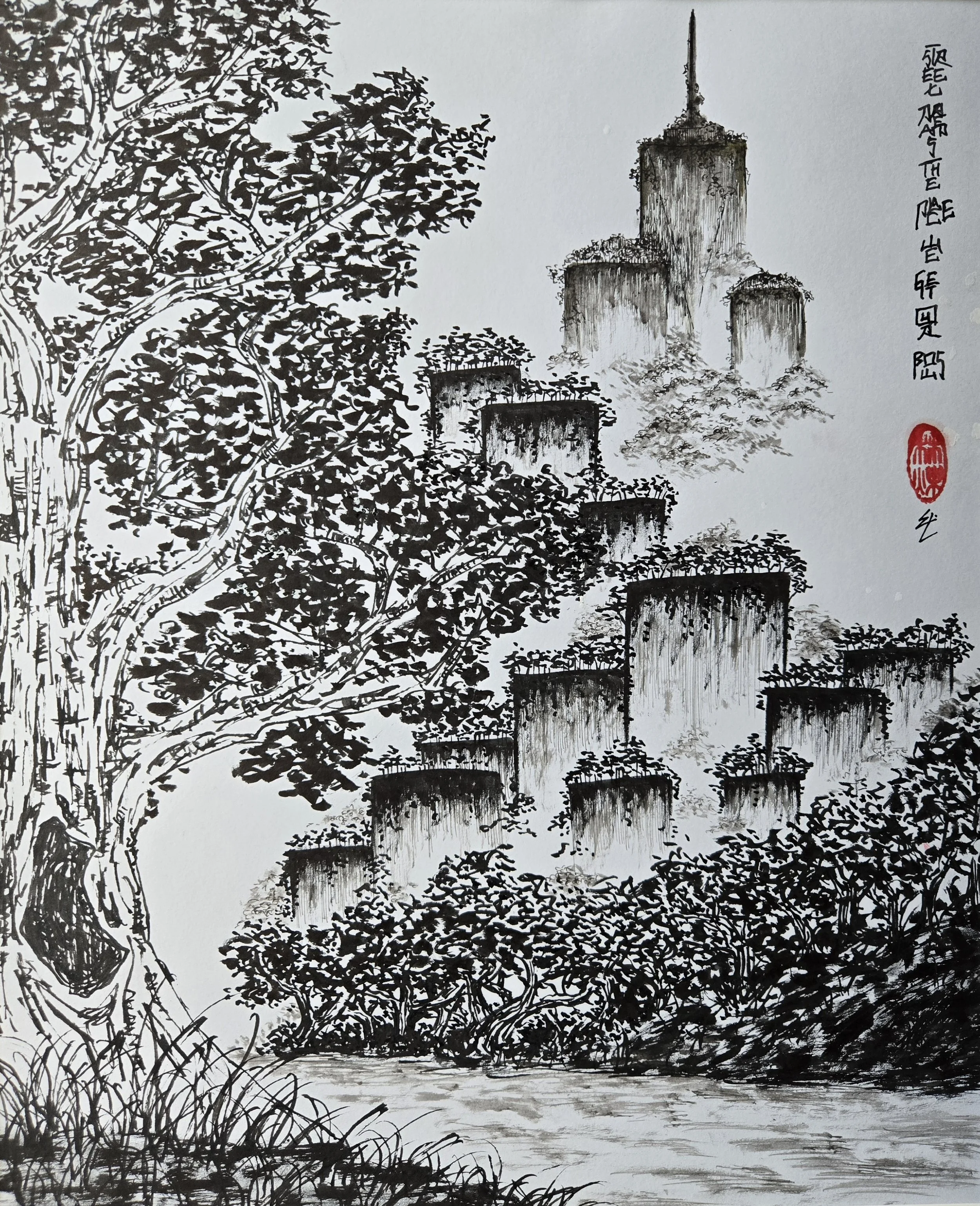
THE PLACE WHERE WE GET BOWS
This piece reimagines lower Manhattan if the city was like a forest. This piece pays homage to the original Lenape people that used to live in the area and honors the original name of the island - Mannahatta, which means the place where we get bows. Hickory trees used to be abundant in lower Manhattan and the Lenape people valued them to make hunting bows and arrows. In this reimagined future, native trees and plants of New York will fill the streets and building rooftops. The piece draws inspiration from a drawing called “Manhattan Island in the Sixteenth Century” which showed the landscape of Manhattan at the time, and shansui paintings that depict nature, uses void space, and vertically to convey depth.
sTREEt DREAMS
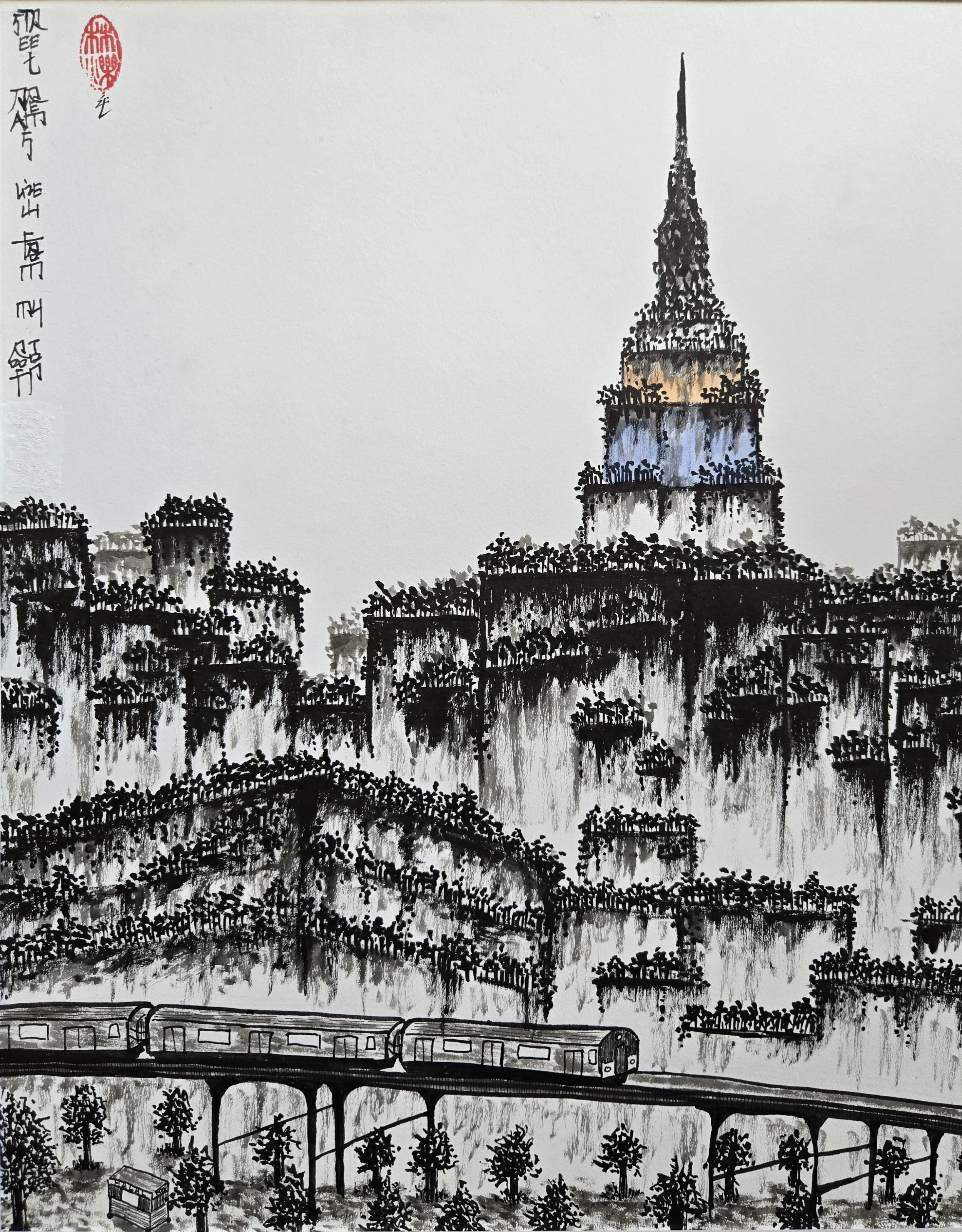
VIEW FROM MY ROOFTOP / KNICKS IN 5
This piece reimagines the view from my rooftop in Long Island City if the buildings across the water in Manhattan. This piece is inspired by shanshui, the Knicks, and an appreciation for the New York City skyline and other iconic imagery like Empire State Building, the subway, and the halal cart. When the Knicks won the championship this year, the Empire State Building and a number of other buildings were lit up in blue and orange. It has been 53 years since the last time the Knicks won it. People used to say that it would be impossible for the Knicks to win another title but this year, they made the impossible possible. They won game 4 despite having a 0.4% chance of winning. They were down 29 points and still came back to win the game, setting a new NBA finals record. If that isn’t inspirational, I don’t know what is. I hope we carry that same energy in the fight against the climate crisis. Climate change feels like an impossible challenge to overcome, especially as the weather becomes more extreme and natural disasters become more common and widespread. But as long as we hold on to hope and keep working, there exists a possibility to fix all this. To quote Mayor Mamdani’s speech from the Knick’s parade, “it is in that 0.4% that we go to work.” Let’s keep working. Knicks in 5.
Today’s science, Earl’s climate future:
Earl Lin
31, New York City, New York
Drawing connects me with my inner self and the outside world. It lets me express myself and appreciate the environment around me. It is meditative, liberating, empowering, and on the best days, effortless - like breathing.
I've loved drawing ever since I was a kid. I filled the margins of my notebooks from elementary school to high school with doodles of everything from the objects in the classroom, to manga characters, to the latest creation from my imagination. I stopped this daily practice in college to focus on engineering coursework and explore my burgeoning passion for climate and sustainability work. It was during this time that I came across the essay “Buildings like trees, cities like forests” by William McDonough and Michael Braungart which argued that buildings and cities should be designed to be in harmony with nature. The article left a deep impression on me and became the north star for my career aspirations. It led me to my first job as a mechanical engineer designing energy efficient buildings and eventually to pursue a graduate degree in urban data science to scale sustainability solutions in cities. It also became the primary source of inspiration for this project.
I became deeply engaged wit my graduate coursework and passionate about the research I was conducting, before everything stopped when the pandemic hit. Remote work, social distancing, and lockdowns led to one of the most challenging times in my life, personally and professionally. Drawing became my source of solace. I devoted myself to studying pen and ink art and developed a practice of drawing everyday. Just like when I was a kid, I found comfort in drawing my surroundings and processed my thoughts and feelings by drawing.
After the pandemic was over, I continued to chase my passion for art. I attended art workshops, explored urban sketching, and attended figuring drawing sessions. In parallel, I resumed my professional career and explored a non-traditional, non-corporate path by working in urban and climate tech startups and non-profits. In order to grow in my career, I eventually returned to a corporate role and pursued a fellowship with the Urban Design Forum. In order to grow as an artist, I attended classes at the Art Student League, explored gallery openings in Chelsea, and participated in group art exhibitions.
Through ink art, I explore and reconcile dualities. Just like how lines drawn in ink can be both controlled like in crosshatching and expressive like in abstract paintings, dualities can coexist harmoniously - engineer and artist, Fujianese and New Yorker, nature and city. There just needs to be balance.
This project finds me at the ten year mark since I graduated from college and began adulting. It also marks the intersection of my professional and art journeys. I am an engineer who works to mitigate climate change by reducing energy consumption and carbon emissions in the built environment. And, I am an artist who uses ink art to tell stories about peoples and places. The journey has led me to this project which gave me the opportunity to combine engineering for climate solutions with art and storytelling, and let me express myself more holistically.