snag
This work by Rachel Cranmer consists of a short story, Snag, and two shadow boxes. The story, beginning in 2030, follows the “afterlife” of a woman and others leaving a chaotic, decaying world to find their final resting place - so it seems. From that loss, new life emerges both naturally and through the efforts of all kinds of people from land stewards to artisans.
The author plans to continue refining Snag, incorporating insights from green death professionals, before seeking publication.
The shadow boxes represent death options:
-
“Forever Young"
A view of traditional burial
Photo taken at a traditional cemetery

-
“Soft Descent"
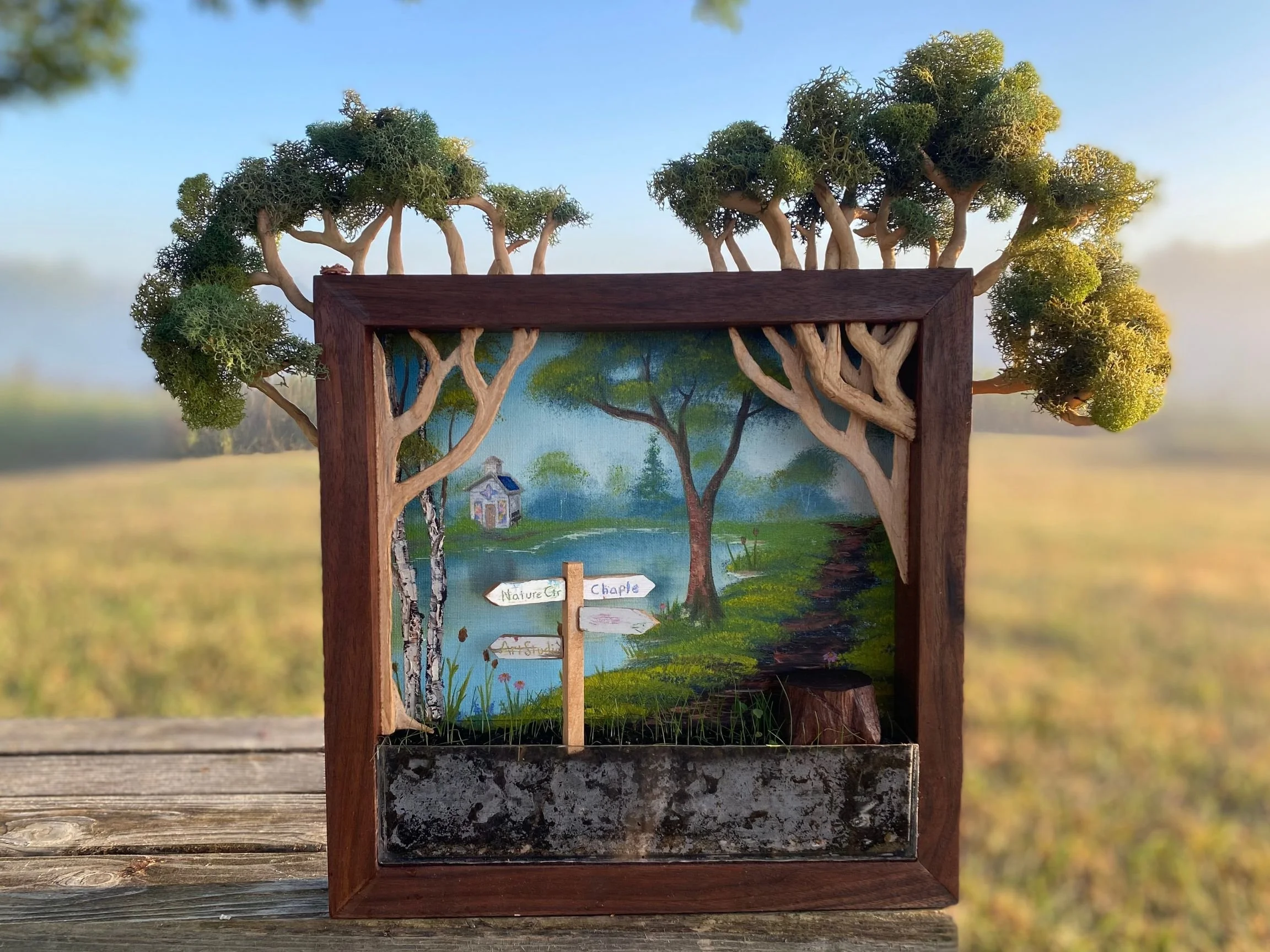
Ascene of green burial
Photo taken at Heritage Acres Memorial Sanctuary, native prairie burial site”
Tour of traditional burial shadowbox at a traditional American cemetery in Ohio, USA
Shadowbox and video by Rachel Cranmer
The first shadowbox depicts traditional burial in an increasingly capitalist near future. Constructed from inorganic materials - plastic turf, concrete, metal, synthetic fabric - this box illustrates the layers of resources found in the burial process. A resin bottle representing embalming fluid preserves a plastic flower as it leaches into the earth. Plastic flowers themselves are common fixtures of litter in traditional cemeteries, but people, like these flowers, are preserved in a way that they can never decompose and return to the earth, only poison it. There is also a price tag printed on the back of a crime scene toe tag, listing real, basic funeral costs and emerging “grief tech”. An “AI twin” is made from childhood and makeup-aged lenticular photos of myself to represent this disturbing, emerging technology that reinforces unhealthy relationships with grief.
The second box illustrates green, specifically woodland burial. The box is built by me and my mother from locally felled black walnut. A Bob Ross–style landscape painting uses oil paint made from pollution runoff from Ohio rivers. Inside, clay bones rest beneath soil from my garden, leaf litter from a favorite cemetery, and bee-friendly lawn seed. Roots and mycelium visibly weave through the earth. In the gallery, the grass will likely die, but the soil remains alive. Clay and moss trees escape the frame, referencing the story's themes of decay and entropy, juxtaposed against the vaults of traditional burial. In this scene are other story references: a multi-faith chapel, a walnut stump marking the protagonist, and wayfinding signs inviting viewers to imagine what a future cemetery could entail - a communal “third place” as cemeteries once were.


Rachel Cranmer
31, Cincinnati, Ohio USA
In 2018, I took a spiritual ecology course in India, visiting dozens of sacred groves - forests revered and protected by communities for their spiritual or religious significance. Sacred groves once existed across most of the world’s indigenous cultures, even in early Europe. I asked, “How can we bring sacred groves back to a Western, secular world? How can we create a culture that values trees so deeply again?” That’s when I began exploring green burial.
Green burial and other environmentally-friendly death practices offer not only ecological restoration but also a way to repair our relationship with death, grieving, and place. As a rural kid, burying family pets and planting trees over them brought comfort. As an adult, my favorite date spot is a cemetery that doubles as an arboretum - lush, historic, alive with wildlife and joggers. Though not strictly green burial, this place inspires me to imagine cemeteries as urban greenspaces full of art and life amidst death. It’s also a good litmus test - if someone isn’t up for a cemetery date, they’re probably not weird enough for me.
Since starting this project, I’ve volunteered at a green burial cemetery near Cincinnati. People of all ages gather there to plant trees, remove invasives, take workshops, and celebrate Earth Day with art, music, death doula talks, bonfires, and potlucks. Seeing elders, families, and young adults reclaiming this forgotten, ”weird” part of environmentalism has kept me passionate about this project.
This piece imagines a world where everyone chooses green burial. Beneath that vision runs a deeper theme: decay, not just of bodies, but of an old, ailing world. From death and rot, something new can grow, reminiscent of a “snag” - a dead tree that, even in death, shelters more life than when it was alive.
Through Climate Storytelling 2075, I’ve realized my conservation work, art, and futures research continually circle back to trees, wildlife, time, place, and mortality. I’ve even explored mortality through land art in published research, finding in nature a model of symbolic immortality we might learn from. I enjoy creating work that sparks emotion - whether its unserious humor or existential tears. I don’t shy away from difficult subjects; as an emerging climate futurist, I approach the future with realism, but also with whimsy. I believe there is beauty in destruction. Stories of building utopia from dystopia offer courage more than just hope.
Confronting death can also reveal injustices that persist beyond life, showing how capitalism and colonialism follow us even to the grave. Yet once the taboo of death planning is broken, I’ve found it can be freeing for people - sparking creativity, empowerment, and new connections.
This story encourages readers to talk about end-of-life plans, to advocate for green death options, and to embrace what eco-philosopher Joanna Macy calls being both hospice workers and midwives: tending the end of an old, unjust world while helping to birth a better one, even if we never see it ourselves. Whether it's through our actions or physically reuniting with natural cycles, we will remain in some way in 2075, 2175, and beyond.
-
-
“How High We Go In the Dark” by Sequoia Nagamatsu - One of my favorite climate fiction novels, this book imagines an unknown pandemic released from the thawing Siberian permafrost that kills many, primarily children. We see how lives, culture, technology, and capitalism are transformed by the scale of death for better or worse. Considering the loss of the boomer generation and mounting ecological catastrophes, how might this scale of death change society? How can we get ahead of it to make the loss less painful and less destructive?
Caitlyn Doughty - This mortician and non-fiction author is one of my favorite YouTubers (see “Ask a Mortician”) and writers. My favorite books of hers are “From Here to Eternity: Traveling the World to Find the Good in Death” and “Will My Cat Eat My Eyeballs”. She is wildly funny and sincere in her reverence for multicultural death and grieving practices. She uses her platform to educate, empower, and promote end-of-life planning. In 2021, I did hers and death doula Alua Arthur’s self-paced meditation course on mortality.
Earth Expeditions’ India: Species, Deities, and Communities Graduate Course - This was the study abroad course I took in 2018 while enrolled in Miami University's Project Dragonfly master’s program in Biology. It was there I learned about sacred groves and spiritual ecology. While there I was deeply interested in vultures and how the Asian Vulture Crisis (where 99% of vultures were accidently killed off in southern Asia in the 1990s) was impacting religious death practices like sky burials. Because few vultures exist and we did not get to interact with Zoroastrian communities, I was not able to spend any time exploring the subject while there, but I was primed to begin exploring the topic of green burial.
Spring Grove Cemetery - This is a local cemetery and arboretum in Cincinnati, Ohio that I often frequent. It is not unusual for people to go there for picnics, runs, or walks with friends or on dates. While not a green burial cemetery, it does have a heavy emphasis on green space as well as stunning art and architecture. I frequently see deer, fish, frogs, and all kinds of birds, even a whole flock of turkeys wandering through the tombstones and obelisks. This is how I imagine cemeteries used to be.
Heritage Acres Memorial Sanctuary - This is a green burial cemetery just outside Cincinnati, Ohio started in 2020. A former agricultural field, it is now a prairie with graves marked by simple markers amongst the wildflowers and trails.
World’s Oldest Trees & the Future Library - I have had an intense fascination with long-lived plants and spent my COVID shutdown researching the world's oldest living plants. More recently, I visited a new forest that won’t live very long but elicited unusual emotional responses in the public across the globe - the Future Library artwork in Oslo, Norway. In fact, my co-author Jenny Liu Zhang and I published a research paper about this project called “The Seeds of Futures Engagement: Oslo’s Future Library and Mortality Awareness on TikTok”. Here we explored the intersection between trees, cultural heritage, and what we coined “post-death FOMO” which led many young people to confront their mortality in ways they likely hadn’t before.
The Deep Adaptation Movement - I ascribe to the Deep Adaptation Movement that believes some degree of near term climate collapse is inevitable and offers emotional scaffolds for confronting that reality and preparing for what’s next. I reference uneven collapse in this story and in Deep Adaptation, the grieving process for the lives and the quality of life (for some of us) we will likely lose is not dissimilar to grieving other types of death. I try to reference these different types of death to show the pain as well as the good that can come of it. I’m still trying to grapple with this theme myself.
-
Tina Isbel - My mother who milled the walnut wood used for the green burial shadowbox and helped me construct it.
Michael Dudley Jr. - For being my writing workshop partner.
My Pod & Writing Group: Robin Moulton & Lovinia Summer
Mariana Castro Azpíroz - For advising me on how Dia de los Muertos could be celebrated in a Memorial Forest.
Cassidy Venoma - For editing help.
Heritage Acres Memorial Sanctuary - For letting me volunteer and ask questions.