Eco Mythologies: Book One
Eco Mythologies: Book One is a monumental sculptural book, four feet in scale, built from wood, metal, paper, and paint. Its covers are constructed like the boards of a real book, weighted and hinged, but built to human proportions; its pages open into a room-sized landscape you can walk into rather than hold in your hands.
The medium is "poetry by way of." Wood, metal, paper, and paint are all means for language and remain the physical foundation here. Each material becomes a way of giving that language a physical prosody.
One page holds an original eco myth; poetry, speculative narrative, and monoprinted imagery layered directly into the wood and paper of the page itself, so that text and image share the same surface rather than sitting side by side. The opposite page is left visibly, intentionally incomplete: raw material, waiting marks, space that reads as unfinished rather than empty.
Visitors are invited to write, draw, and print directly onto it, using the tools and marks the installation provides. Over the course of the exhibition, that page fills, and the book itself changes shape.
The scale is deliberate. A four-foot book asks to be approached the way a mural or a fresco is approached, at the scale of the body, rather than the way a book is normally approached, at the scale of the hand. Standing inside its open spread, a viewer becomes small the way a viewer standing before a wall of paintings becomes small; the difference is that here, the wall writes back.
The result is a book that does not stay fixed. It records what one voice made and leaves room for many more; by the end of its time on view, its unfinished page carries handwriting, drawings, and marks from strangers who walked through the space and decided to stay long enough to add something to share eco-wisdom archived into the future.
Book One in an ongoing series, The Eco Mythologies.
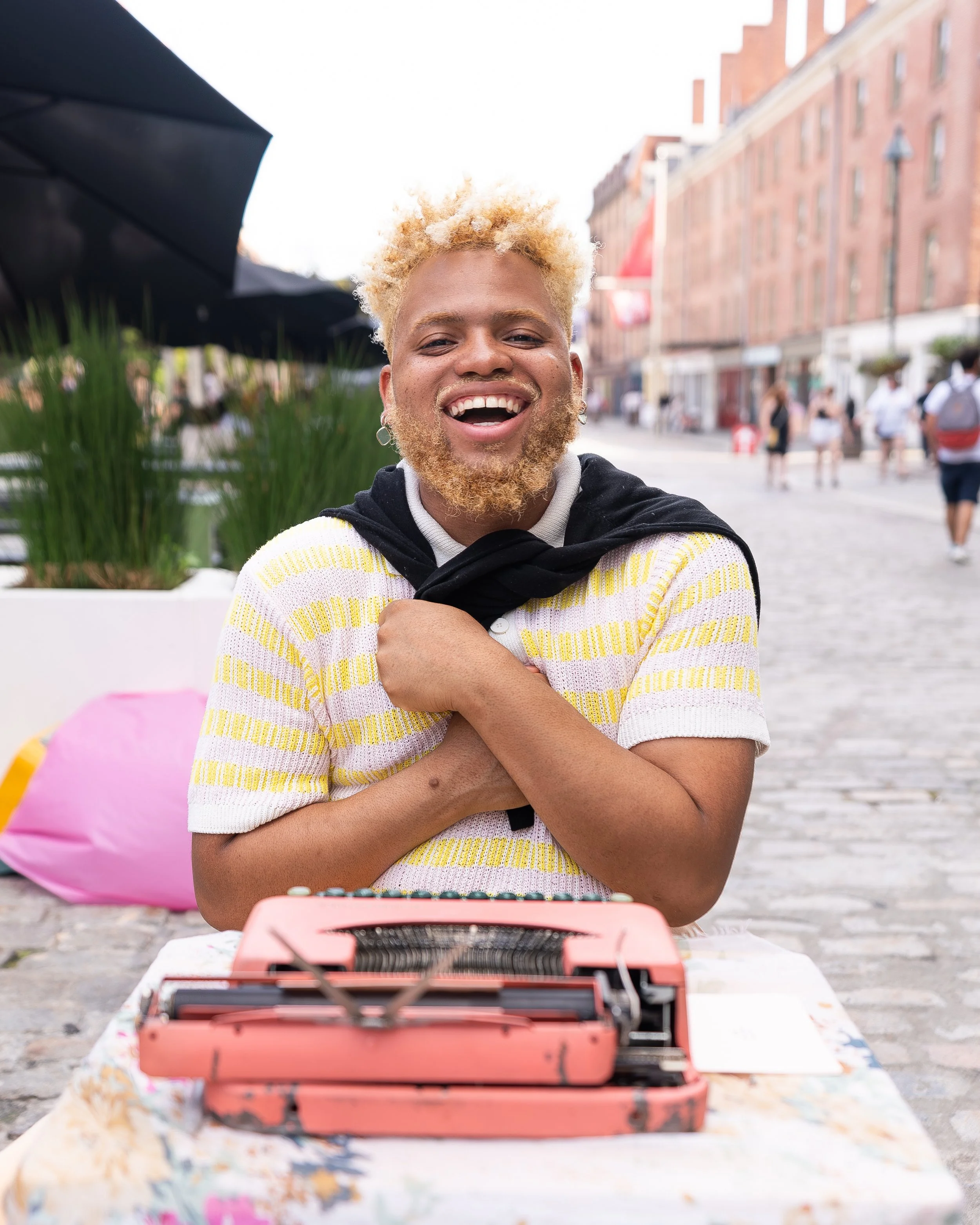
Jayshawn Lee
28, New York, NY
Eco Mythologies: Book One emerges from a practice built around a single idea: poetry by way of. Poetry is always the foundation of my work; the materials I build with, wood, metal, embroidery, and now the paper and paint of a monumental book, are the bridge that lets language take on the prosody of another medium. Across earlier projects, including Climate Haikus, the People's Poetry Cart, and Wall Poesia, I have asked what happens when poetry leaves the page and becomes an experience. The Eco Mythologies extends that inquiry into sculpture, installation, and speculative storytelling.
I am interested in the relationship between climate change and cultural memory. Climate change is most often communicated through projections, statistics, maps, and images of catastrophe; knowledge that is essential but doesn't always give people a language for imagining what comes after. My work asks what poetry and myth can offer in that space. Myths have historically let communities explain their relationships to land, water, animals, ancestors, seasons, and one another. I build in the form of the book because books are also technologies of memory: they preserve stories so they can travel beyond the people who first made them. By enlarging the book to four feet, built in wood, metal, paper, and paint, I turn reading into an embodied, communal encounter; closer in scale to the large canvas, the cave mural, or the fresco than to anything meant to sit on a shelf.
Book One contains an authored story alongside an intentionally unfinished page. That unfinished space is essential. Rather than presenting climate futures as something I alone can define, I invite visitors to become co-authors; their writing, drawings, and printed marks become part of the work.
The same impulse behind that unfinished page shows up everywhere I make. I regularly gather fragments of people's stories in public and write them back to them on typewriters ranging from 1908 to 1960, often working in my best fragmented Portuñol/Portunhol alongside single words or phrases in whatever language meets the moment, depending on who I encounter and where. That practice insists that a story doesn't have one point of origin; it belongs to whoever carries it forward, in whatever language or fragment they carry it in. Typewriters themselves are part of that belief: they are ancient technologies of archiving, tools that have already survived one era of obsolescence to keep holding language, and I've long been drawn to keeping that kind of tool alive in my hands rather than letting it become only a museum object.