In Dialogue with Displaced Species:
Water Caltrop
Lorena James
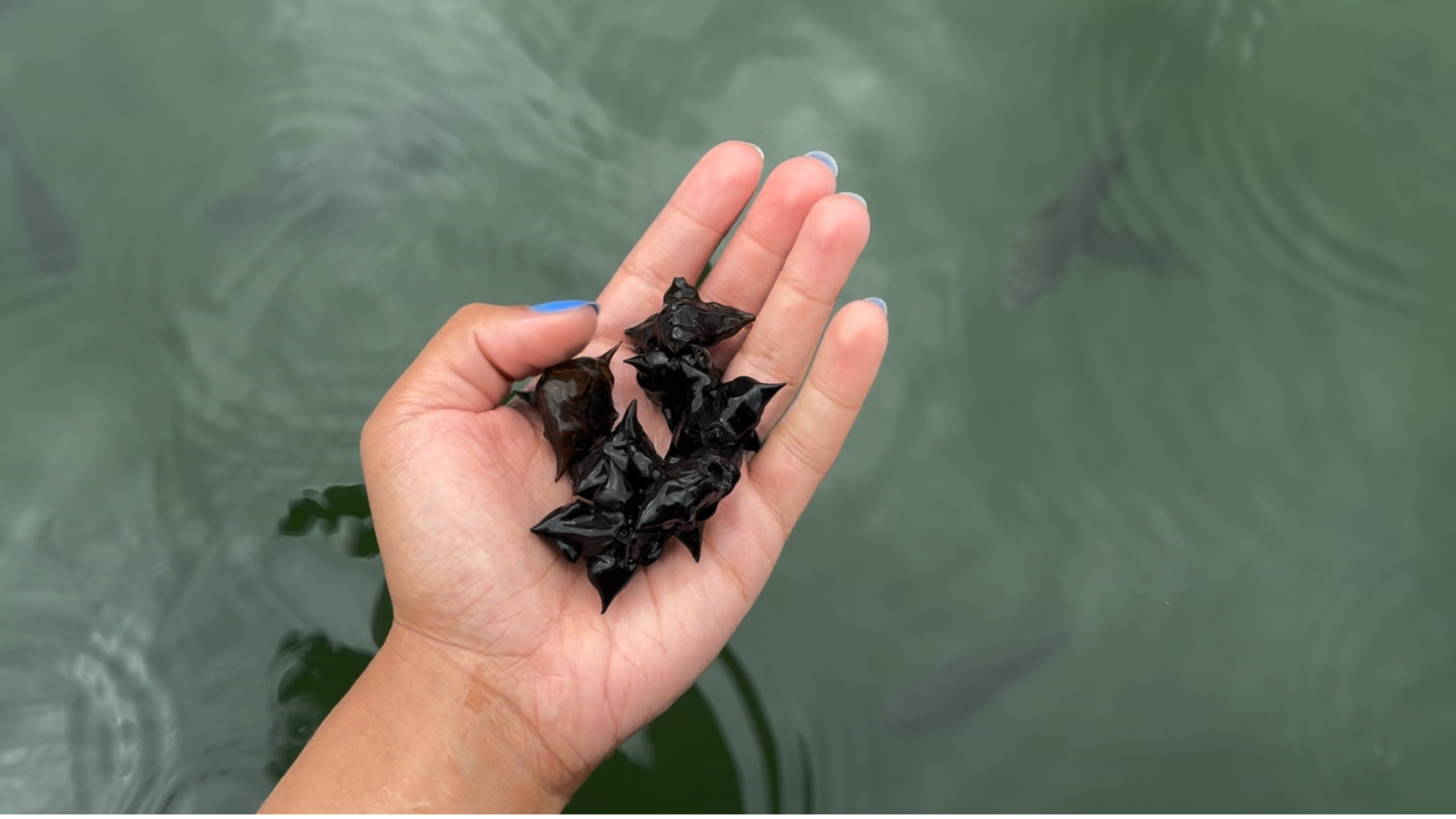
In Conversation with Displaced Species: Water Caltrop is a multidisciplinary performance and wearable art piece – choreography, music, fashion, and poetry – staged at the water's edge in dialogue with a plant carried by many names: water caltrop, singhara, 菱角 (líjiǎo), bat nut, devil pod, of the genus Trapa.
Water Caltrop is a floating aquatic plant native to the freshwaters of Europe, Africa, and Asia, where for centuries it has fed festivals, street markets, and family tables – roasted on sidewalks in Italy, folded into Mid-Autumn Festival dishes, gathered along the shores of Lake Victoria. In the waterways of the northeastern and mid-Atlantic United States, that same plant is invasive and can cause harm to native biodiversity: its dense floating mats shade out native plants, deplete dissolved oxygen, and choke habitats that native species depend on. This ecological harm is real; however, we ask you, the viewer, to consider how we can hold that harm alongside everything else the plant is: a source of nourishment, a piece of cultural memory, a living thing that did not choose to cross an ocean, but finds itself a lost traveler.
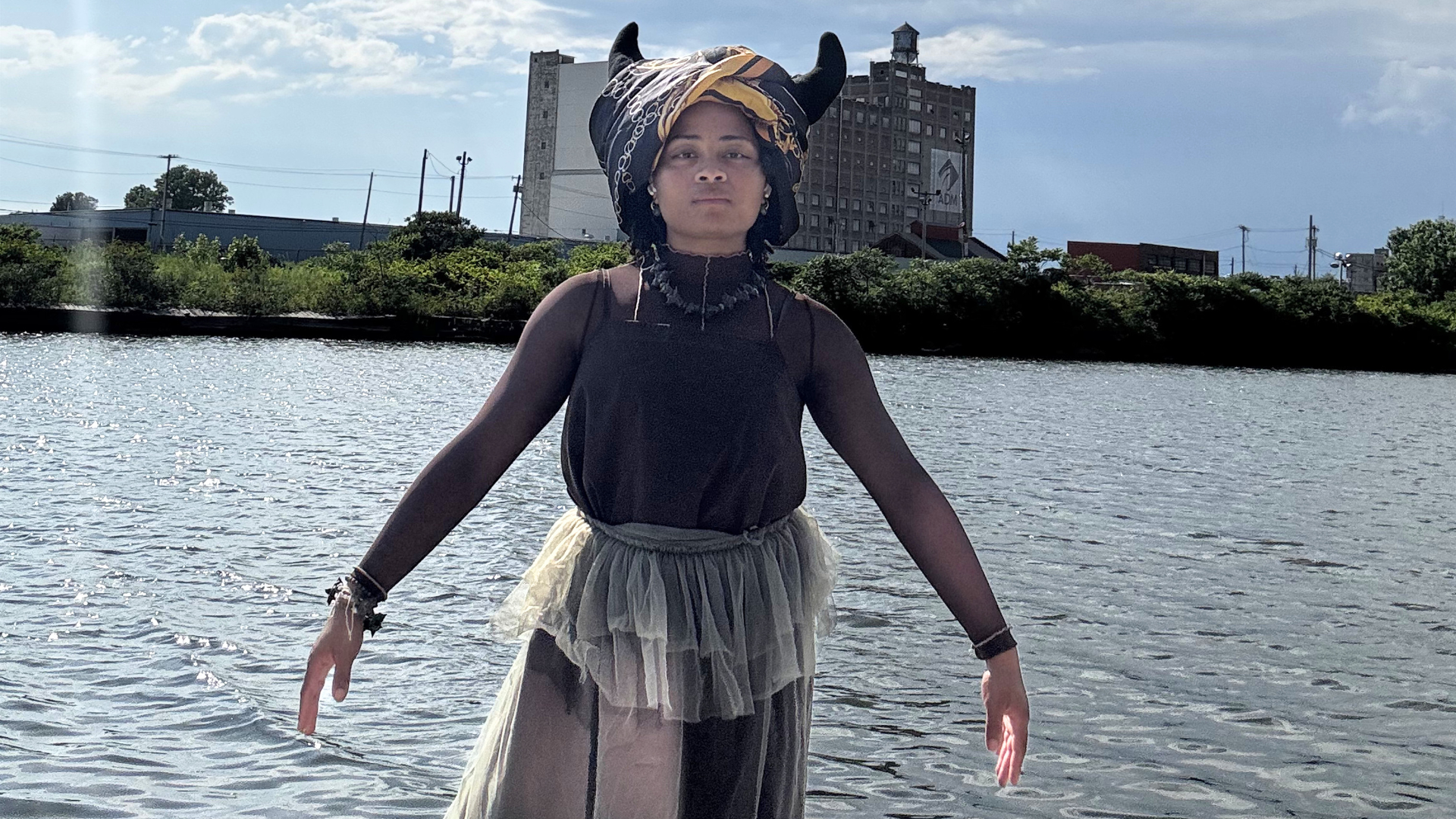
The performer wears a headdress built from the plant's own architecture – two curved horns echoing the seed pod that gives water caltrop its nicknames "bat nut" and "devil pod" – paired with a necklace of dried seed pods and a flowing skirt, moving through natural space in choreography that traces the same arc as a scientific invasion curve with slow attentiveness.
This piece argues for a more holistic and culturally adaptive lens on invasive and displaced species: one where protecting native biodiversity and honoring a plant's history in the places it came from aren't opposing goals, but two things careful management can hold at once.
Devil Pod
Written by Lorena James
Inspired by Watert Caltrop, Singhara, 菱角, Trapa.
Born in flooded stillness,
glossy and black,
horned like something
Nana kept on the mantel.
Too delicate to touch
But now lost in a box under the stairs
With pictures and memories of friends
And family no one earthside recalls
Called devil. Called bat.
Called invasive.
Called weed.
Round and patient
A seed beneath the surface,
With lifeforce within.
Filled with the soul of many places to call home.
She travels so far,
With skin thin enough to peel
inside, something
Filled with stories of crossed rivers
Purple mountains, and starry nights
She sits
beside someone weeping
over something they called small.
But there’s nothing small
in the body of leaving.
Through warehouses,
through machines that bow and drink
beneath the sherbert sun
And she carries on.
And carries the memories of souls in motion
bent into fields before dawn,
then mailed in envelopes
to places that would hollow them,
Skin them, and feed them porcelain platitudes
because of what the skin holds.
Named devil for the exterior
horned, dark, alien,
faces on both sides,
That sees past, present, future
All at once.
Remembering
that particular weight of rain
on standing water,
A flooded field
holding sky
like a mirror
faced to the stars
Stars that cross the Milky Way to arrive,
still trembling with its river,
saying without words:
not alone in your crossing.
All revolutions start with a poem or a song
So ‘dance with the wild animal, not the pelt’
And bring your hunger.
And your thirst.
Because I’ve traveled this whole impossible distance
to meet you
at the water's edge,
where everything
that has ever moved
began.
Today’s science, Lorena’s climate future
-
New York Sea Grant, "Compost Invasive Plants into Fertilizer" – a nature-based, closed-loop practice: harvested invasive biomass (like water caltrop mats) is composted into fertilizer instead of landfilled, cutting demand for synthetic fertilizer and its associated emissions. https://seagrant.sunysb.edu/ais/pdfs/CCD-StewRegan-AISCompost0812.pdf
-
Project Drawdown, "Protect Coastal Wetlands" – one of the most well-evidenced nature-based climate solutions, protecting and restoring wetland ecosystems (which invasive floating mats like Water Caltrop degrade by blocking light and depleting oxygen) for their outsized carbon storage and water-filtration value. https://drawdown.org/explorer/protect-coastal-wetlands
-
This work is part of my broader practice at Invasive Impact Initiatives, where the Remove, Repurpose, Restore framework above is put into action. https://invasiveimpact.org
Lorena James
27, Buffalo, NY
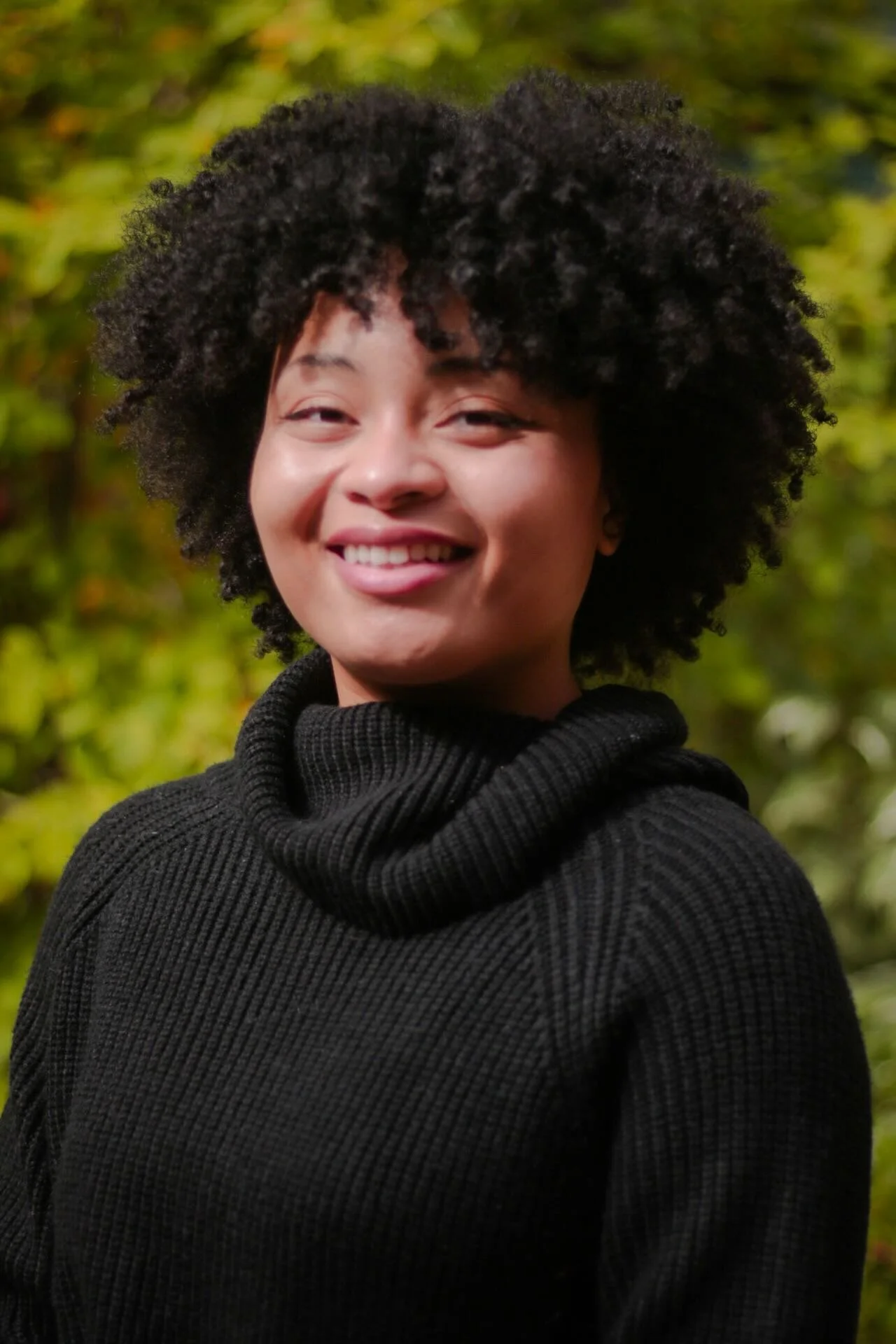
I grew up on the shore of Lake Erie in Buffalo, NY, gardening, fishing, and hiking waters that taught me early that ecosystems don't hold single stories; a plant, a fish, a shoreline can be a resource, a threat, and a home all at once, depending on where you're standing. That's the lens I've carried into Invasive Impact Initiatives, where I work to build community with invasive species upcyclers using a Remove, Repurpose, Restore framework: pull what's genuinely harming a native ecosystem, and instead of discarding it, turn it into material, food, or art that honors where it comes from.
In Conversation with Displaced Species: Water Caltrop explores this framework holistically. This piece goes beyond conventional invasive species management and digs into the history and cultural meaning held within Water Caltrop. This plant has fed families across Asia, Europe, and Africa for generations, appearing in festival dishes, roadside stalls, and home kitchens long before it arrived in the Great Lakes and other waterways in the U.S. Discussing it only as a threat erases that entire history.
By 2075, I want a climate future that can hold both truths at once without flattening either: real, evidence-based ecological management, and a culturally adaptive curiosity about what a displaced species carries with it and what it might still offer the place it lands. This piece is my attempt at that in miniature – a body wearing the plant's own horned silhouette, standing by the water where it finds itself as a lost traveler, refusing to be only a threat or only a treasure. That refusal, worn on the body, is the future I'm storytelling toward.